Client Story

Rheinbahn AG

The Rheinbahn, founded in 1896 as Rheinische Bahngesellschaft AG, is the local transport company of Düsseldorf, the capital of North Rhine-Westphalia.


Strategy specialists from our company worked with experts at Rheinbahn to develop a plan for its future growth. They identified twelve fields of action and showed which measures Rheinbahn can take to become a modern mobility provider with more passengers.

Strategy and Growth
Performance Improvement
Mobility, Transportation, and Infrastructure
Reading Time 3 Minutes
Key Results
Systematic improvements in the core business
including a new service concept and the expansion of the Rheinbahn app.
Expansion of the range of services
especially on high-traffic bus lines.
Development of new business models
by setting up and expanding a multimodal mobility package.

The challenge

Rheinbahn AG is a public transit operator in the Düsseldorf metropolitan area. Due to increasing numbers of commuters and new mobility needs, the company faces the task of rethinking its future development.
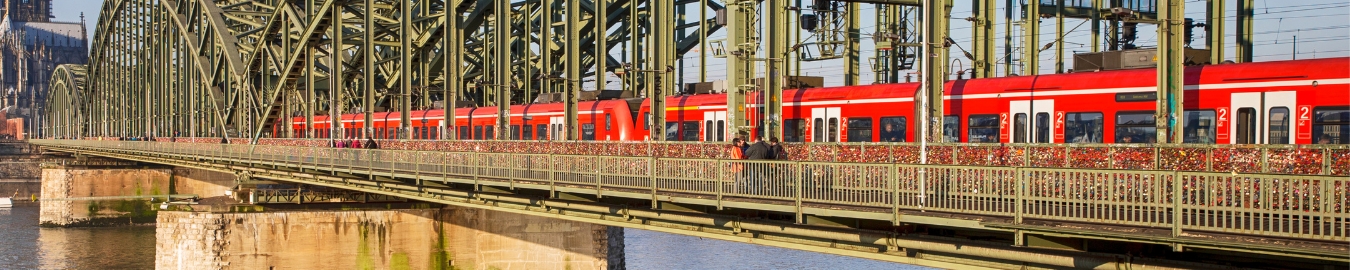
Train on the Hohenzollern Bridge in Cologne crosses the Rhine.

The solution

Strategy specialists from us worked with experts at Rheinbahn to develop a plan for its future growth. They identified twelve fields of action and showed which measures Rheinbahn can take to become a modern mobility provider with more passengers.

In doing so, the strategy team examined the business cases in great detail and analysed best practices for a bus rapid transit concept. The result was a three-stage strategy with which Rheinbahn aims to grow three times as fast as the city of Düsseldorf during the coming five years. 

Key results

The strategy begins with systematic improvements in the core business; these include, among other things, a new service concept and the expansion of the Rheinbahn app. Stage two involves expanding Rheinbahn´s range of services, especially on high-traffic bus lines. In the third stage, the company will develop new business models by setting up and expanding a multimodal mobility package.  

The strategy was presented to the public in the fall of 2016. Crucial elements of the project´s success were the degree of detail in its planning and the close cooperation by us with internal and political stakeholder. 

Ready for tomorrow?Get in touch and see how our team can help you.

What's new?You might also be interested in...

Insight
Article
April 2026
The Map Before the Storm
Is PE Looking at the Right AI Risk?
Insight
Article
April 2026
The strategic thesis was right. The P&L disagrees. Where to look
In private equity, value erosion rarely comes from a fundamentally flawed thesis. More often, the thesis, the priorities, and the operating model simply fail to align — quickly enough, or tightly enough — during the hold period. In tech-enabled industrials, that gap tends to be wider, more persistent, and more expensive to recover from
Insight
Brochure
April 2026
M&A Industry Snapshot: The European PropTech and ConTech M&A market
The European PropTech and ConTech M&A market is regaining momentum, but under fundamentally changed dynamics. Capital has become more selective, strategic buyers are increasingly dominating transaction processes, and single-point solutions are losing relevance despite strong growth.This snapshot highlights a clear shift toward scalable SaaS platforms with recurring revenues, deep workflow integration, and strong data foundations. Buy-and-build strategies remain the primary growth lever for investors, while AI-enabled platforms combining operational data and automation capabilities are commanding increasing strategic premiums.As recent transactions such as the Consigli deal demonstrate, valuation is no longer driven by revenue alone, but by a company’s role within future platform ecosystems. As a result, well-positioned platforms benefit from an attractive exit environment, while demand for mid-market add-on acquisitions remains strong.