ExpertiseAI-native Operating Model
Everyone is flying AI –few are redesigning the runway for real productivity gains
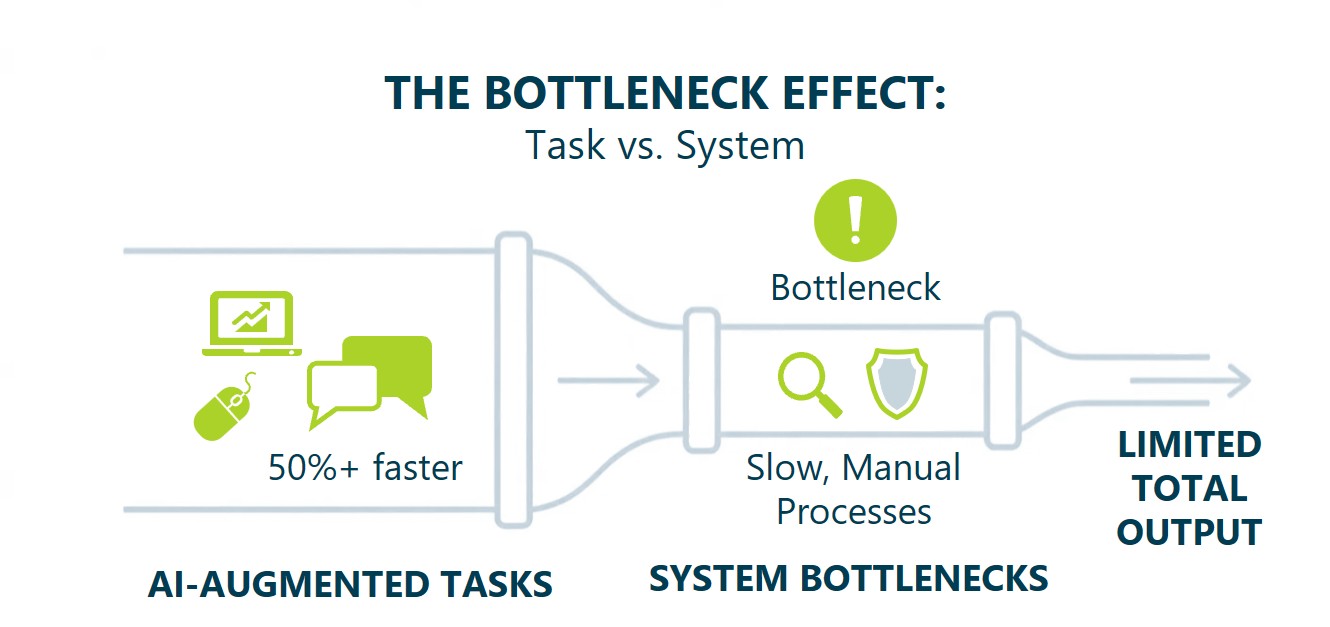
AI adoption is accelerating across industries. Tools are widely available, pilots are everywhere, and use cases continue to grow. Yet, measurable productivity gains remain limited.
The reason is structural. Most organizations apply AI on top of operating models designed for a pre-AI world. Roles remain unchanged, processes fragmented, and governance disconnected from execution.
As a result, AI improves isolated activities but fails to transform overall performance.
Most organizations focus on identifying more AI use cases or reducing costs. This leads to fragmented initiatives without lasting impact.
The relevant question is different: how to systematically increase output per euro through AI.
This requires a consistent transformation logic that connects use cases, operating model design, and execution. The objective is not more AI, but structurally better performance.
X "Automation cuts effort. Augmentation multiplies impact. AI-native operating models are engineered across the entire value chain."
Philipp Mudersbach, Managing Director at Fortlane Partners
Philipp.Mudersbach@Fortlane.com
Making Productivity Measurable at its Source
To move from fragmented use cases to structural productivity, organizations need to redesign how work gets done. This means shifting the focus to roles and tasks, where AI impact can be made transparent, measured, and systematically scaled. Only then can AI overcome system bottlenecks and translate local efficiency gains into overall performance.
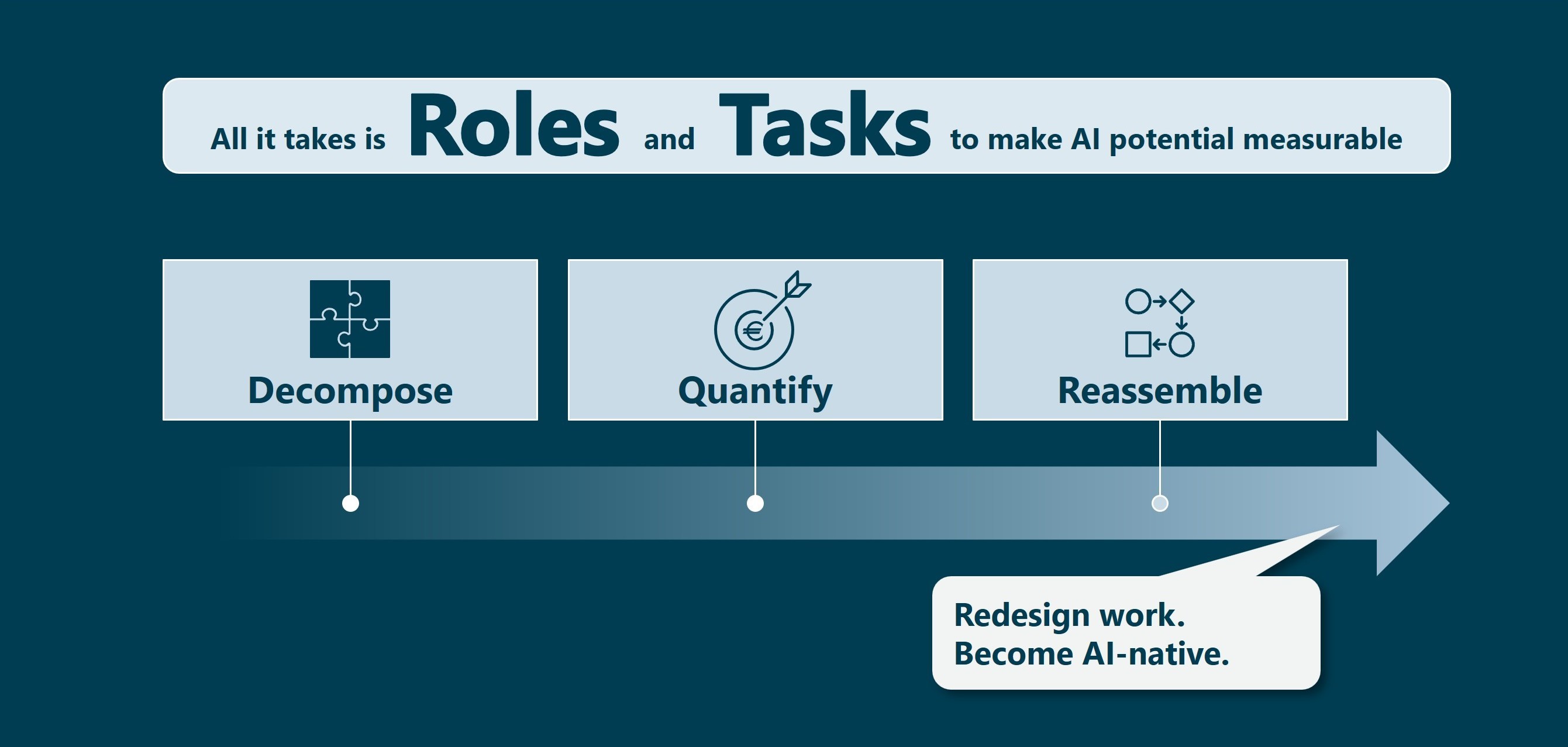
We break down every role into its underlying tasks and work becomes transparent at the value creation level. We structure and standardize role and activity data to reflect how work is actually performed across the organization. This creates a consistent, granular foundation capturing tasks, time allocation, and process logic as the baseline for analysis.
We measure AI exposure and economic impact at task level – in euros, not theory. Based on state-of-the-art task-based frameworks (Acemoglu et al.) and recent AI research, we assess automation and augmentation potential and quantify impact, effort, and dependencies. This results in a fact-based view on AI value pools and implementation complexity, validated with business and technical stakeholders.
We redesign roles and workflows by reassembling tasks based on automation depth and value. We translate insights into concrete changes by redefining roles, adjusting processes, and specifying required capabilities and system enablers. The outcome is an organization, that embeds AI into daily operations and enables scalable productivity gains.
Building on this logic, we apply a structured approach tailored to your organization. Starting from your data, we create full transparency on task-level AI productivity potential, validate results with your experts, and translate insights into a concrete transformation path. This ensures a consistent link between analysis, operating model design, and execution toward an AI-native operating model.
X "AI-driven productivity gains stem from reimagining how work is done, not merely accelerating existing processes."
Adrian Drettmann, Principal at Fortlane Partners
Adrian.Drettmann@Fortlane.com
The outcome of our AI Productivity Assessment is a comprehensive view across roles and tasks, with a clear distinction between automation and augmentation potential. The application enables you to navigate both the breadth of roles and the depth of tasks to define a tailored, high-impact AI productivity roadmap.
Example assessment of 146 roles and 2,667 tasks for an automotive supplier:
contact the teamMeet our experts in AI-native operating model