ANGA COM 2025 in Cologne: Why the fiber boom is maturing now and what companies should do immediately
ANGA COM 2025 signals a shift from pure build out to profitable gigabit execution.
The opportunity is in the multi dwelling segment and in building wiring, because the last meter drives take up and cost per connection.
Take up is managed as a performance funnel and requires product, process, CPE, Wi Fi, and proactive support, not more construction meters. The copper-fiber-migration is a transformation program where customer experience, communications, operating model, and regulation are the multipliers. Winners pair an experience layer with connectivity plus content, because it scales revenue density, ARPU, and retention.
Scroll down
Abstract
ANGA COM 2025 signals a shift from pure build out to profitable gigabit execution. The opportunity is in the multi dwelling segment and in building wiring, because the last meter drives take up and cost per connection. Take up is managed as a performance funnel and requires product, process, CPE, Wi Fi, and proactive support, not more construction meters. The copper-fiber-migration is a transformation program where customer experience, communications, operating model, and regulation are the multipliers. Winners pair an experience layer with connectivity plus content, because it scales revenue density, ARPU, and retention.
Exec Summary
ANGA COM 2025 felt less like the “Next Big Thing” and more like a reality check. On the one hand: strong international participation, a solid program, and a market that continues to push technology hard. On the other hand: a noticeable shift in mindset. The central question was no longer whether gigabit is coming, but how gigabit becomes profitable.
From a strategic perspective, five macro trends dominated:
- From build out to adoption: focus on multi dwelling units (MDU), in building wiring, and take up rates. The last meter becomes the most important meter.
- Copper → fiber as a transformation project: migration is not only technology, but also customer communication, processes, and regulation.
- Consolidation and cooperation: endgame logic, scale effects, open access, and capex discipline replace uncontrolled expansion.
- Quality of experience instead of speed only: low latency, stable home networks, and Wi Fi performance, because customer value is created in daily use, not in a speed test.
- Connectivity meets content: streaming and TV are not add-ons, but part of the commercialization logic, covering retention, bundles, and monetization.
In short: ANGA COM 2025 showed that the gigabit market is entering a phase where execution matters more than vision.
Stating the obvious
The biggest elephant in the room is this: homes passed is not a revenue metric. Network build is visible, but monetization depends on two levers that have been underestimated for too long.
- 1) Multi dwelling units (MDU) and building wiring are the new competitive core
When fiber sits “in front of the building,” the real battle starts: access to buildings, ownership structures, wiring, in building distribution networks, installation capacity.
That is exactly why in building wiring moved to the center of attention at ANGA COM. Strategically, this is logical: whoever industrializes multi dwelling unit execution cleanly gains the biggest lever on volume and on cost per connection. - 2) Take-up is a product and process problem, not an infrastructure problem
The industry increasingly discusses take up the way a SaaS company would: funnel, conversion, retention, support costs. Why? Because every additional percentage point of take up can change the economics of entire rollout areas without building one extra meter.
This is where the link to technology becomes tangible: Wi-Fi 7, better CPE, remote management, proactive support. This is not “nice to have.” It is part of the adoption machine. Adoption is the fastest way to convert capex back into free funds.
A useful mindset shift:
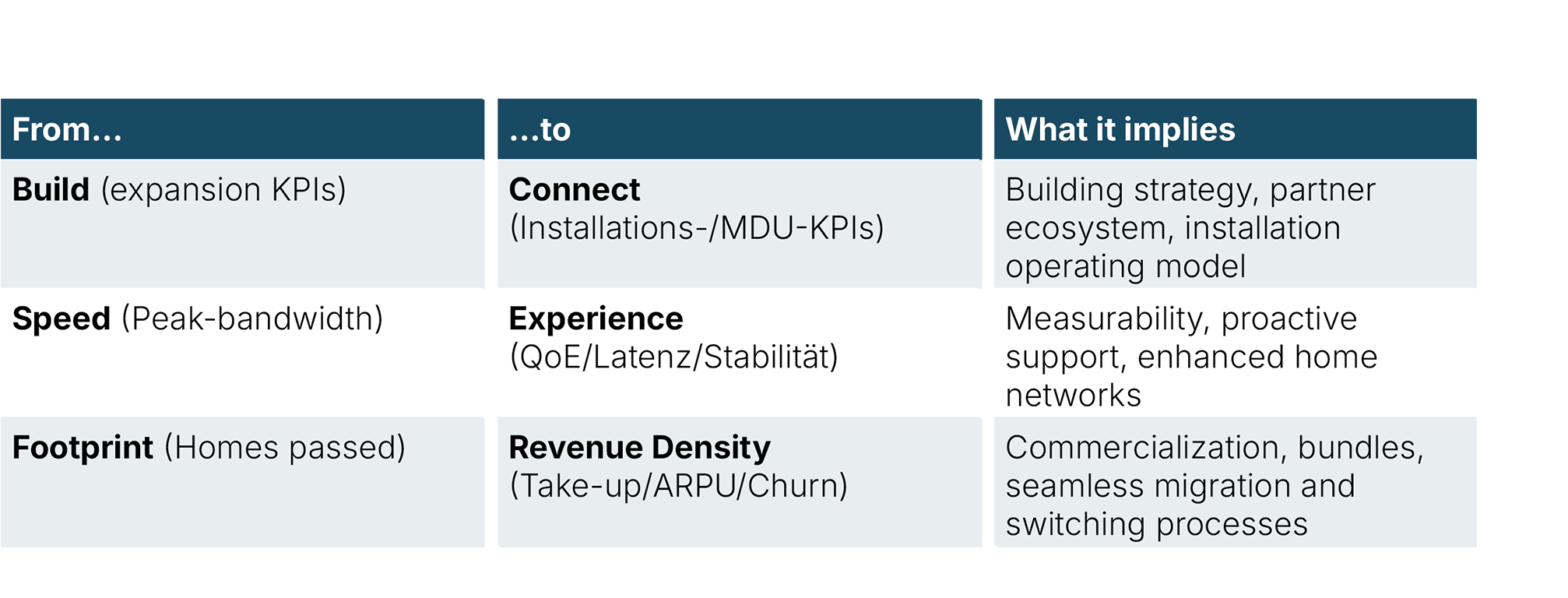
This is the core message ANGA COM 2025 delivered between the lines: the market is becoming operational.
Winners & Losers
This is less about individual logos and more about strategic positioning.
Winners (strategic):
- MDU and building network players (including platforms and integrators): Whoever standardizes the last meter becomes the gatekeeper of adoption. That pulls an entire supplier chain with it, including B2B2C processes, property managers, installation partners, and measurement and monitoring tools.
- Technology providers that sell evolution instead of dogma: Approaches looked particularly strong when they allowed multiple upgrade paths, for example HFC→DOCSIS 4.0, targeted fiber, PON, while also operationalizing QoE topics such as latency.
- Providers that treat home networks as a product: Wi Fi performance, mesh, remote management, resilience against outages. These are not only consumer features, they are conversion features for FTTH.
Losers (strategic):
- Build-only strategists without a commercialization machine: Anyone selling footprint as success while failing to industrialize take up runs into an ROI trap, especially with rising cost of capital.
- Everyone betting on a big bang TV and streaming switch:
The discussion around the end of the ancillary cost privilege made clear how slow mass migration really is. Expectations were visibly adjusted downward. That is a warning sign for go to market plans that rely on sudden consumer movement.
Hidden Gems
Some of the most important signals were not headline-ready, but still highly relevant strategically:
- Regulation as a growth factor, not only a risk: The question “What needs to change after the election?” is not political decoration. It signals that the industry sees permitting processes, planning reliability, and the competitive framework as productivity levers.
- Internationalization of the discourse: More English language panels and international perspectives indicate that European learnings, fiber first, multi dwelling focus, open access, are increasingly viewed as a blueprint.
- QoE and low latency as a new sales argument: Not because it is “cool,” but because gaming, video conferencing, and streaming become measurably better. This is the moment when network upgrades move from an engineering case to a marketing case.
Take-away
What should companies do now, concretely?
Build or buy a multi dwelling and building wiring playbook: Owner and property manager models, standard offers by building type, installation partners, clear SLAs, and scalable processes.
- Manage take up like a performance channel: Segmentation, offer design, onboarding, switching service, field service optimization, proactive support. KPI stack: take up, time to connect, cost per connect, churn.
Set up copper → fiber as a transformation program: Technical migration is one part. Customer experience, communication, and regulatory clarity are the multipliers.
Prioritize the experience layer: Wi Fi 7, mesh, remote management, outage protection, not as a feature list, but as an adoption and retention strategy.
Think connectivity plus content as a bundle strategy:
If you want to keep households, you need relevance. Bundles, partnerships, and simple activation are often the fastest path to higher revenue density.
ANGA COM 2025 was therefore less a showcase for individual products and more a mirror: The gigabit-future is here. Now it is about who translates it into profitability.
ContactGet in touch



What's new?You might also be interested in...