Open gateway unlocked: Why Open Gateway is not the average telco play
The telecommunications industry is constantly evolving, and mobile network operators (MNOs) must adapt to new trends and technologies to remain competitive.

Scroll down
Even though mobile network infrastructure serves as the heart of global digitization, it has been largely inaccessible to anyone not connected to telco companies for a long time. However, the rise of platform business models has made it essential to enable direct access to key networking functions with flexible and cost-effective configuration.
Open Gateway (OG) is a GSMA-led, opensource initiative aimed at bridging this gap. It provides developers worldwide with seamless network access through novel network application programming interfaces (APIs). Initially launched with 21 MNOs globally, Open Gateway has expanded its reach since its introduction at the Mobile World Congress 2023 in Barcelona. It now encompasses 32* telcos, covering approximately 50% of mobile connections worldwide.
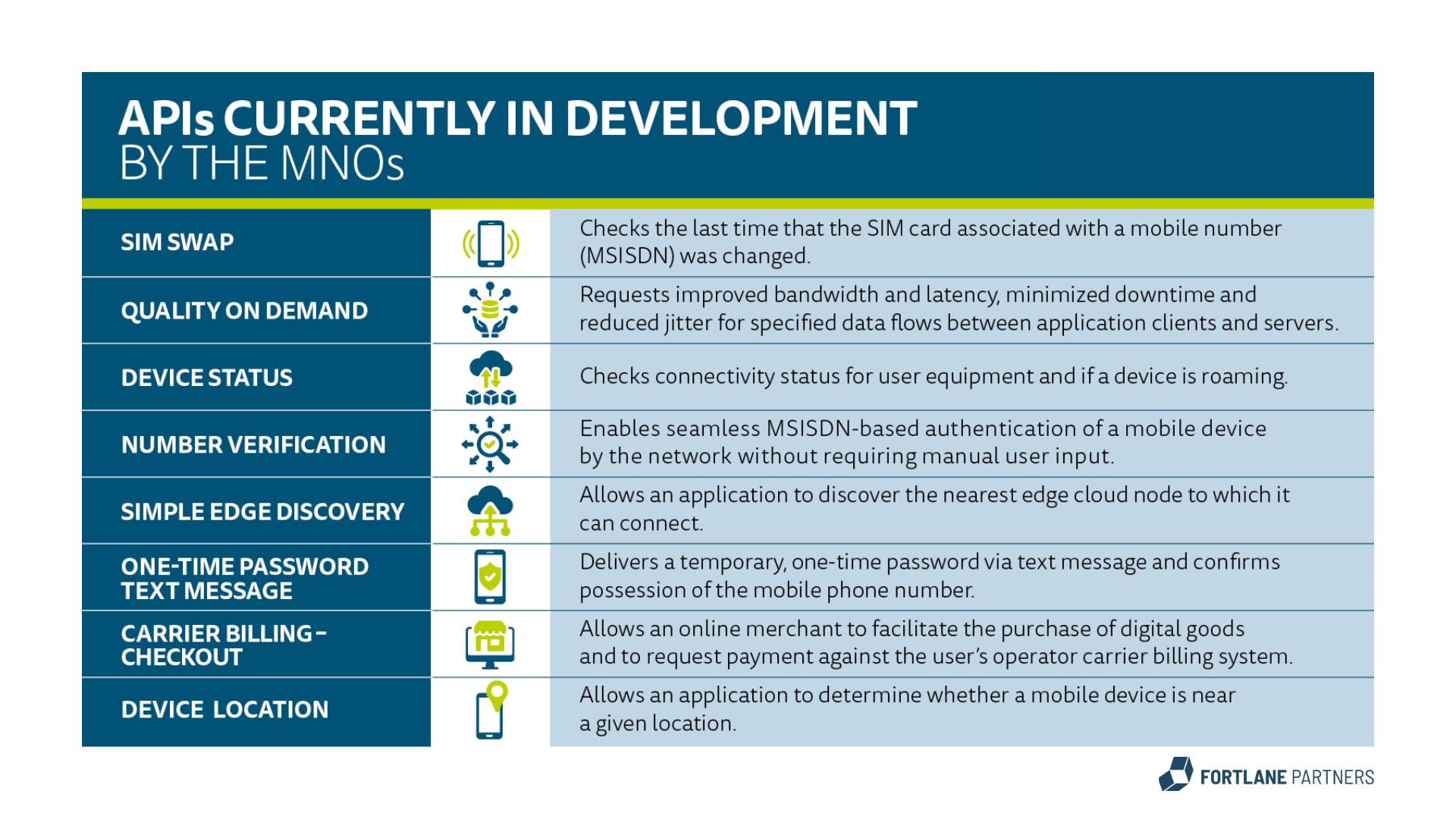
At launch, Open Gateway comprised of eight network APIs, jointly developed by the MNOs in alignment with the CAMARA alliance (a project conducted by the GSMA and the Linux Foundation). These network APIs are readily accessible to third-party providers, such as hyperscalers, aggregators and service developers. More APIs will likely be added once these ecosystem members formulate their demand for innovative use cases.
When integrating telco services into their products, developers must establish the Open Gateway connection just once. Afterward, the novel network APIs can be used to interact with any MNO involved in the initiative. Development efforts are reduced, and the need for deep understanding of MNO-specific network functioning is eliminated. Instead, developers are enabled to quickly deploy a wide range of novel services in identity, security, billing and quality on demand.
APIs currently in development by the MNOs
On the MNO side, however, Open Gateway stands out with a vastly different approach compared with the traditional wholesale business model known to the telco industry. Unlike the classical model, where MNOs primarily compete against each other, a different competitive landscape is introduced. In many Open Gateway use cases, the competition does not exclusively come from other MNOs. Instead, success in “multi-MNO use cases” relies on leveraging the existing SIM base of each telco. Otherwise, such kinds of use cases won’t be effective at all. Hence, joint go-to-market strategies and collaborative efforts among MNOs to effectively address these are critically important.
To realize the full value of Open Gateway, MNOs must package multiple APIs into comprehensive services that cater to specific use cases. This allows MNOs to effectively market their offerings to developers, presenting them with not only novel technical tools, but also holistic solutions. For example, combining APIs related to user identity and anti-fraud measures can result in powerful solutions addressing multiple customer needs.
Furthermore, Open Gateway can revitalize the text-message OTP authentication business, whose growth curve has begun to flatten out, and turn it into new business. By transitioning legacy volume to Open Gateway, MNOs can retain their footprint in the growing authentication market.
Based on these observations, 5 distinct key areas in Open Gateway can be pinpointed, each of which requires the close attention of telco decision makers.
Many Open Gateway use cases require coordinated efforts among multiple MNOs to persuade service developers to implement network APIs. Dedicated strategies, joint go-to-market approaches, coordinated sales measures and product demos are essential to acquire large-scale partners effectively.
Open Gateway offers the potential to transform existing text-message OTP authentication into a new business opportunity. This is crucial as traditional text-message-based two-factor authentication is being gradually replaced by more user-friendly and cost-efficient alternatives, including proprietary authentication services and biometric solutions like fingerprint or face recognition.
To break free from the traditional mindset of “one service, one price tag”, MNOs need to adopt a more innovative and holistic approach to product development. They must explore the option of tying together various APIs, modeling tailored products and developing distinct pricing plans to maximize the potential of Open Gateway.
Separating from hyperscalers is impractical since they remain the primary lever for maximizing market reach. MNOs should focus on establishing partnerships to enhance scale and make their API products more appealing to developers. Diversifying across multiple providers reduces dependencies and mitigates cluster risks associated with the use of just one provider.
Unlike traditional telco services with well-defined service ranges, Open Gateway services are still evolving and require active collaboration with developers. MNOs should engage developers early in the process to co-create new products or iterate on existing services, ensuring flexibility and market alignment.
Summary
Open Gateway represents a significant opportunity for MNOs to actively drive innovation, unlock new business possibilities and embrace new revenue streams. By understanding its unique dynamics and adapting strategies accordingly, MNOs can position themselves at the forefront of this technology and reap its benefits.
Although the range of use cases with the existing and future set of network APIs is theoretically unlimited, telcos need to be cautious: Cooperation between telcos must not be limited to joint development of APIs. The only way to efficiently reach hyperscalers, aggregators and large corporations is by employing a carefully coordinated sales strategy that utilizes the weight of about 50% of global mobile connections.
Eventually, collaboration, customer-centricity and a proactive approach to product development will be the key to unlocking Open Gateway’s full potential.
Sources: Fortlane Partners, GSMA
KontaktSprechen Sie uns an

Was gibt es Neues?Das könnte Sie auch interessieren...