Toward an overdue transformation in sales commissions
Telco players are under pressure due to increasing commoditization
of services, declining core revenues as well as high infrastructure investments. Therefore, they need to revamp their sales and go-to-market (G2M) approach to secure market positioning and enable future growth. A key component of this endeavor is sales enablement and steering through refining and optimizing commissions for dealers and internal sales units.

Scroll down
Outdated, complex and inefficientlegacy systems
In general, many commission schemes have historically grown overwhelmingly complex due to new or adapted tariff options, promotions, or other marketingrelated campaigns, setting the scene for inefficiency and frustration. Moreover, partner structures continue to require increasingly convoluted setups and contractual agreements which enable fraudulent behavior by agents.
Additionally, changing customer behavior poses challenges to commissions schemes in a variety of ways: On one hand, a growing focus on digital sales channels requires careful balancing and harmonization of on- and offline channels and their respective commissions. On the other, customers are more aware of being able to exploit attractive contract offers when switching providers. This, in turn, puts pressure on providers to create and market such ‘switching offers’ to offset their own churn which significantly drives subscriber acquisition costs.
Because of these sustained outdated structures, the commission budget is often not allocated to the most impactful points of sale, i.e., digital sales, but rather stays locked up at offline transaction points, i.e., retail shops. Despite their role in differentiation, sales commissions are often not at the core of strategic considerations. Optimizing these outdated legacy systems means designing commissions as simple as possible, but as comprehensive as necessary, with enough built-in flexibility to adapt to changing market environments. However, the cost and effort of transforming such legacy commission schemes often seem so lofty that plans to alter them are left unfulfilled.
Benefits of optimized salescommissions (OSCs)
By transforming outdated commission schemes, OSCs ensure a company’s success in several ways: Alignment with company targets ensures that everybody is pulling together, thereby eliminating inefficiencies and diametrical forces. Additionally, a reduction in complexity enables companies to precisely steer their sales channels individually or jointly. This reduction also introduces agility in the commission schemes, with which fast and unbureaucratic reactions to market and consumer trends can be attained.
Furthermore, OSCs schemes play an important role in building a skilled and successful salesforce by creating transparency on sales performance. This transparency allows for the introduction of positive feedback loops where top performers can be identified, appreciated, and rewarded for their performance.
Similarly, sales staff not reaching their goals can be identified and supported with training. This leads to a general increase in skill by rewarding high-performing employees and supporting the low-performing ones, while transparency enhances perceived fairness, thereby raising morale and job satisfaction.
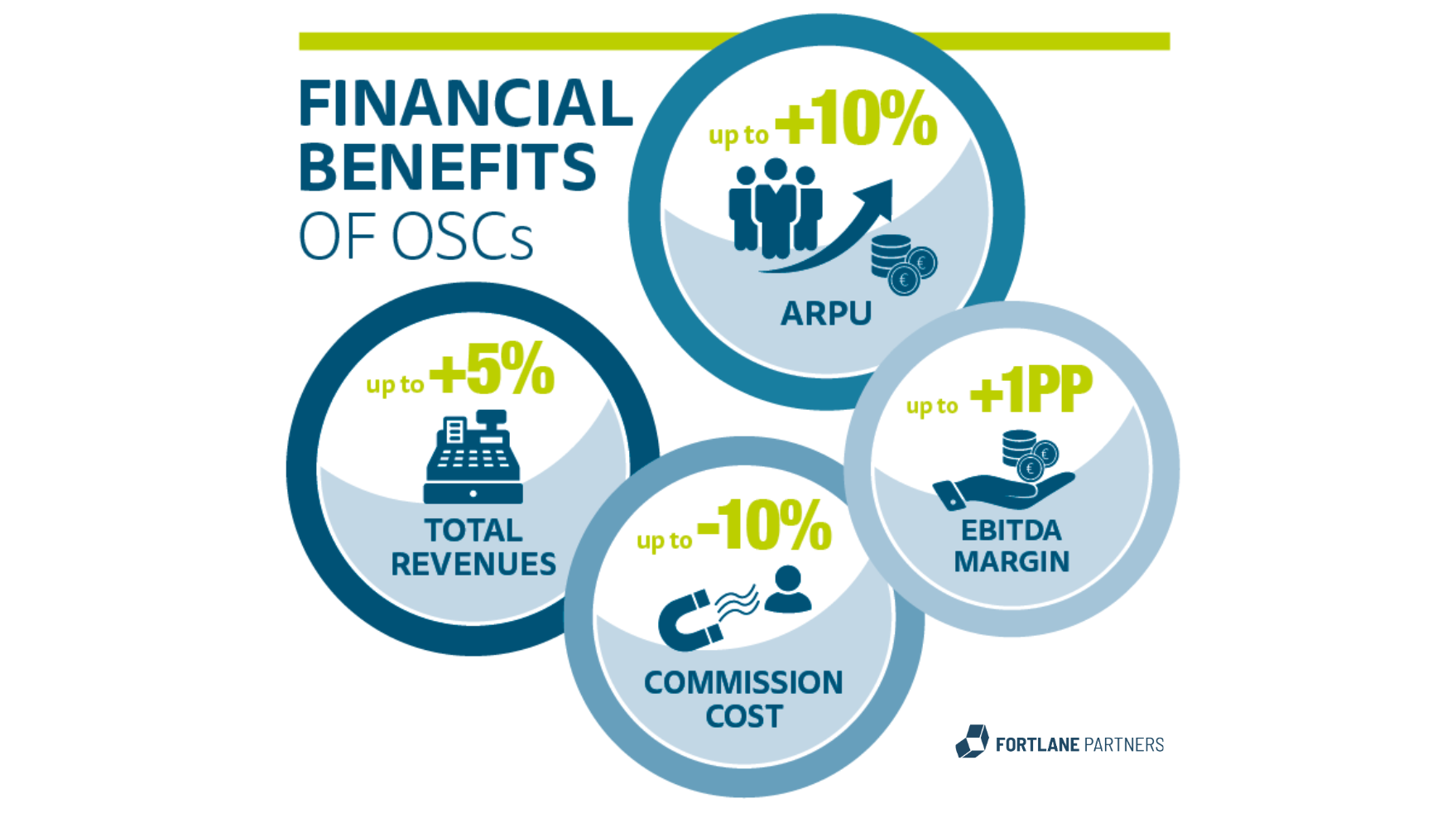
These benefits of an OSC scheme are ot only qualitative and ‘soft’, but also translate into financial results: According to a Fortlane Partners project benchmark, revenues increase by up to 5% when employing OSCs. Similarly, ARPU increases up to 10% while subscriber acquisition costs can be simultaneously reduced by as much as 10%.
Optimizing your salescommission schemes
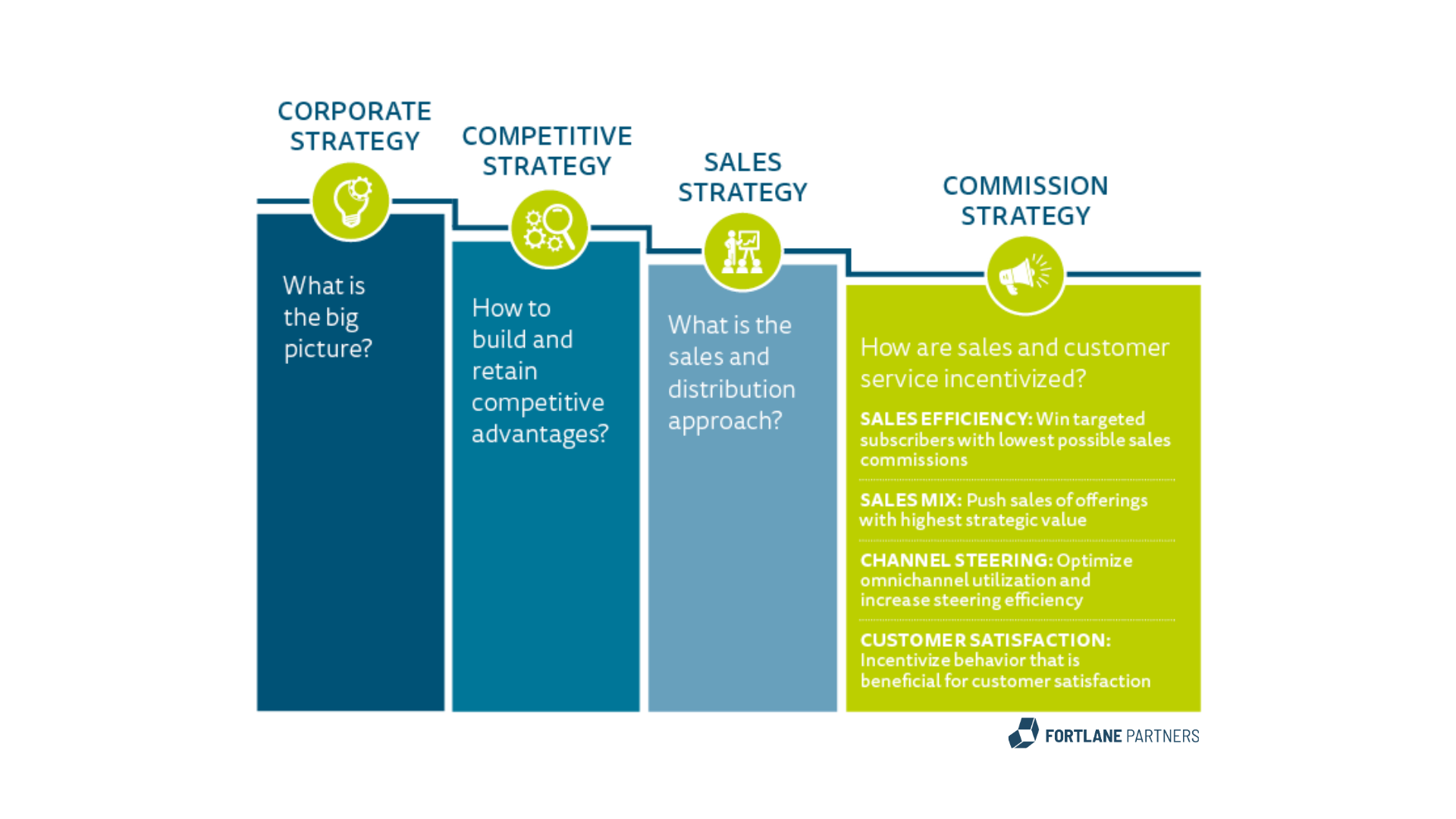
Optimization starts at the top: An OSC strategy is developed based on corporate, competitive, and sales strategies under the guiding principles of sales efficiency, sales mix, channel steering, and customer satisfaction: How do we target consumers with the lowest possible sales commissions, while selling products that generate the highest value? How can we optimize our omnichannel approach and promote digital channels? How can we incentivize behavior that increases customer satisfaction? How can we be successful in close competition with other telcos (particularly in multi-brand shops)?
After strategy formulation and goal definition, commission schemes targeting the various strategy components (e.g., one-time commission plus recurring bill size for enhancing customer lifetime focus) are derived. However, successful implementation also depends on the presence of enabling factors such as suitable processes, an appropriate IT landscape and an aligned organizational setup. Additionally, a standardized and continuous process is required that monitors performance, challenges and reviews the status quo continuously. This circumvents falling back into the same ridged outdated structures. Such a transformation toward OSCs may seem like a big endeavor, but it is absolutely necessary in order to pave the way for the future of sales.
Summary
To offset growing external pressures, telcos need to revamp their sales and G2M approach and integrate commissions into the core of strategic considerations.
One step is to optimize sales commissions, as most legacy systems have grown outdated, complex and inefficient. The latter is often exemplified through a misalignment between off- and online sales channels.
Through transforming sales commissions, telcos strengthen internal sales efficiency, mindset and employee motivation, as well as significantly increase revenue and ARPU while decreasing subscriber acquisition costs. To achieve this, an OSC strategy is developed based on OSC principles and commission schemes. Additionally, enabling factors such as processes, IT landscape and organizational setup are to be adapted as well.
Sources: Fortlane Partners
KontaktSprechen Sie uns an

Was gibt es Neues?Das könnte Sie auch interessieren...